Table of Contents
1. The fragrance of a lineage
The story of Shri Vanshi Ali Ji begins in a stream already flowing with Bhagavat-bhakti.
Traditional accounts connect him to a distinguished Saraswat Brahmin family rooted in Braj. In this lineage stands Pandit Shri Narayan Mishra, praised in Bhaktamal as a profound exponent of Śrīmad-Bhāgavatam, whose heart was captured by Braj and who settled in Mathura. (Jagat Ananda Das)
Generations later appears Shri Pradyumna Goswami Ji, a revered sevak of Shri Kishori Raman Ji at Lalit Kunj near Śṛṅgār Vat in Vrindavan; from this house is born his son—Vamsidhar Mishra, who will be known to the world as Shri Vanshi Ali Ji. A108
Most sources place his birth around Aśvin Śukla Pratipad, 1707–1708 CE, in the atmosphere of Braj-bhūmi and its living rasa. Jagat Ananda Das+1
Already in the telling, one senses the pattern: scholarship, devotion, and Braj–saṁskāra converging to prepare a vessel for something far more intimate.
2. The child of Radha’s Name
Hagiographical traditions, cherished within the Lalita Sampradaya, narrate that from infancy the boy refused to drink milk—until a Brajvasi, cradling him, uttered the Name “Shri Radha”, at which he at once began to suckle.
Whatever one’s stance towards miracle-tales, this episode expresses a truth that his whole life will confirm: his life-force awakened only at the touch of Radha-nāma.
As he grew, the young Vamsidhar delighted in:
- Reciting Radha-centric verses,
- Playing on the banks of Yamuna after snān, absorbed in Bhāgavata,
- Naturally gravitating to Rādhā’s sweetness more than to conventional religiosity. (Vraja Rasa – O néctar de Vrindavan)
The seed of rasik-bhāva had already sprouted.
3. Brilliant mind, melting heart
By boyhood, Vamsidhar Mishra was recognized as an exceptional scholar—well-versed in Sanskrit grammar, logic, śāstra, and the Bhāgavata. Accounts describe him speaking with such clarity that even senior paṇḍitas were astonished. Jagat Ananda Das+1
One famous incident in the court of Maharaja Sawai Jai Singh of Jaipur is often recalled: when learned men hesitated over a subtle theological question about Kṛṣṇa’s conch (Panchajanya), the young Vamsidhar explained using the principle that the Lord’s weapons are conscious, eternal associates—appearing and disappearing in līlā according to divine purpose. The king, struck by his depth, is said to have declared him no ordinary child. Jagat Ananda Das+1
This brilliance, however, did not puff him with pride. It refined into seva-śāstra: scriptural understanding entirely at the feet of Rādhā.
4. Householder years & the breaking point of grace
In obedience to family dharma, he married in his mid-teens; later a son, Pundarīkākṣa, was born. He assisted in responsibilities connected with temples and disciples, including what came to be known as Badā Mandir (Ladili Ji ka Mandir) in Delhi. Vraja Rasa – O néctar de Vrindavan
Yet the more he moved among wealth, patronage, and position, the more intensely his heart turned only toward Shri Radha’s festival, Shri Radha’s seva.
A pivotal moment remembered in the tradition:
- On Radha Ashtami, hearing the kīrtan describing Kirti Maiya’s palace overflowing with Rasa, he plunged into such ecstasy that he lay unconscious in prema for a long time.
- On regaining consciousness, he abandoned all calculation and spent huge sums in Radha’s celebration—once and again—seeing wealth as meaningful only in Her service. Braj Ras – Bliss of Braj Vrindavan.+1
Concerned elders urged moderation. Very soon after, during the Nadir Shah invasions and looting of Delhi, much of the wealth they had anxiously guarded was lost—while that which had gone into Radha’s seva remained forever sanctified. This contrast cut deep into his heart: what is not placed at Her feet is never truly secure.
Out of this insight, detachment ripened. Vanshidhar turned decisively toward an exclusive life of bhajan.
5. Meeting the Guru: Shri Lalita Sakhi as Guide
In Vṛndāvana and Lalit Kunj, his inner life opened into something astonishing.
According to the tradition preserved in Lalita Sampradaya sources, Shri Lalita Sakhi Herself became his Guru:
- Bestowing mantra and direct inner guidance,
- Revealing to him the path where Lalita is Ācārya, and
- Commanding him to go to Barsana for deep bhajan, with the promise of Shri Radha’s darśan. Vraja Rasa – O néctar de Vrindavan+1
In one of his verses he expresses that for him, Lalita is even “higher” than Radha—not in essence, but in gratitude—because through her mercy he attained exclusive shelter at Radha’s feet. This is the classical Bhakti principle: the Guru who reveals God is worshipped first.
From this current springs what later is recognized as Lalita Sampradaya: a tradition where
- Shri Radha is the sole sovereign,
- Shri Krishna is lovingly seen as sevak of Her lotus feet,
- Shri Lalita Sakhī is the Guru-tattva leading jīvas into Nitya Nikunj.
6. Twelve years in Barsana’s dust
Obeying Lalita’s command, Shri Vanshi Ali Ji went to Barsana, the homeland of Shri Vrishbhanu Nandini.
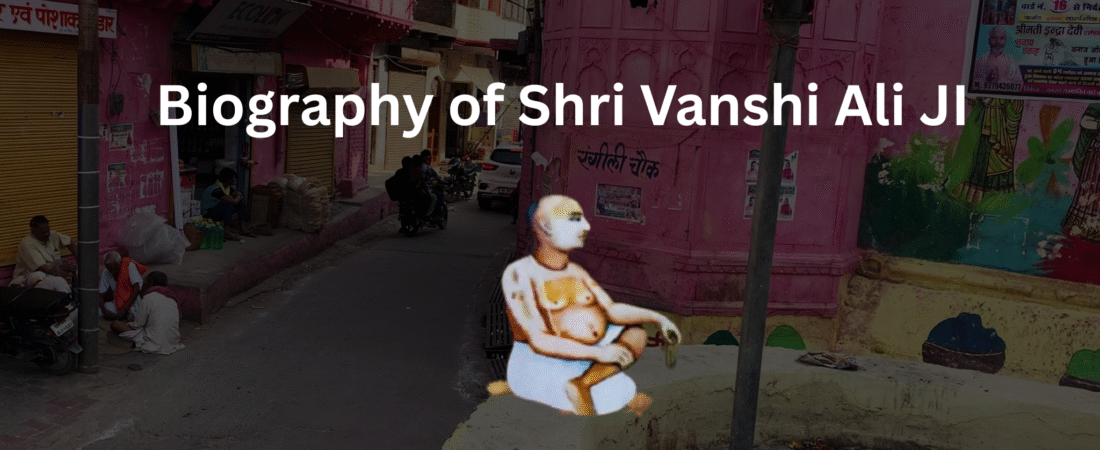
There, in Rangili Gali, he chose to sit exactly where people discarded rubbish. When a village mother asked why a saint would select such a place, he replied in essence:
“Here the dust of Radha’s devotees constantly rises and falls upon me. What better fortune can I ask for?”
For twelve years he remained in that humble spot, absorbed in smaraṇa of Ladli Ji, chanting, weeping, living on little, seeking nothing but the particles of Barsana’s dust and the inward vision of his Swaminiji. Vraja Rasa – O néctar de Vrindavan+1
This is the heart of a rasik:
no demand for position, no outer show of renunciation—only an unbroken inner relationship with Radha.
7. Revelation of the sakhī-svarūpa
Later, in Barsana and Vṛndāvana, a famous incident reveals the depth of his realization.
When Shri Vanshi Ali Ji, in a state of inner absorption, moved toward the close area (Jagmohan) of Ladli Ji’s temple—where access is strictly limited—the sevait tried to stop him and even struck him with his wooden paduka, concerned for maryādā.
At that moment, by divine arrangement, the sevait perceived two simultaneous forms:
- the external form of a humble saint,
- and the subtle form engaged in intimate seva of Shri Radha as Her sakhī.
Overwhelmed, the sevait begged forgiveness. But Shri Vanshi Ali Ji instead thanked him, saying that by his apparent harshness, Shriji had fixed him eternally as Her maidservant, and accepted that sevait’s lineage as “tīrtha-guru” (pilgrimage-guru) for his own descendants. This story is treasured in oral tradition and underlines how fully his identity had shifted into sakhī-bhāva. Vraja Rasa – O néctar de Vrindavan
Shri Vanshi Ali Ji is thus remembered in his line as a realized sakhī of Radha, not merely a devotee observing from afar.
8. Rasik theology: Shri Radha at the center
Through works like Śrī Rādhā Siddhānta, Vṛishbhānupur Śatakam, and other padas, Shri Vanshi Ali Ji articulated a refined, fearless theology. Key threads—expressed here in simple language—include:
8.1 Shri Radha as Supreme Prema-svarūpā
For Shri Vanshi Ali Ji:
- Shri Radha is the very form of pure love, beyond dry scriptural calculation.
- She is the indwelling sovereignty in whose heart Krishna Himself seeks refuge.
- The highest spiritual attainment is exclusive, tender service to Radha’s lotus feet, in the mood of Her intimate sakhīs. Braj Ras – Bliss of Braj Vrindavan.+1
8.2 The glory of Radha-nāma
He teaches that:
- Remembering Radha’s Name purifies even the most fallen and uplifts them beyond social and karmic bondage.
- The dignity of a soul is measured not by birth, but by their connection to Radha-nāma and Radha-bhaktas. Braj Ras – Bliss of Braj Vrindavan.+1
This is radical compassion wrapped in rasa.
8.3 Dham-tattva: Places marked by Her Name
In one celebrated teaching, he exalts:
- Any abode bearing Radha’s Name,
- Any place woven with Her līlās,
as siddhi-pradā—a ground where sincere residence (even mentally) accelerates perfection. Instagram
Thus, Barsana, Vrindavan, Radha-kunda, Lalit Kunj are not mere geography; they are extensions of Her heart.
8.4 Beyond union and separation
In his reflections on nitya-vihāra, he points to a rasa-state:
- where union and separation cannot be neatly distinguished,
- where love is so absolute that both appear simultaneously transcended and harmonized.
This subtle vision matches the heights of rasik literature: it is the nectar where Radha’s sovereignty, Krishna’s sevā-bhāva, and the sakhīs’ service meet as one current. Braj Ras – Bliss of Braj Vrindavan.
9. Lalita Sampradaya & kinship with other Radha-pradhān traditions
From these realizations emerges Lalita Sampradaya, shaped by Shri Vanshi Ali Ji:
- Shri Radha is sevya (the sole worshipful Queen).
- Shri Krishna is lovingly seen as Her servant and instrument, receiving glory through serving Her will.
- Shri Lalita Sakhī is Guru-rūpā, the one through whom entrance into Nikunj-līlā is granted.
- The sādhaka aspires to become Radha-dāsī in Lalita’s group, not an independent enjoyer. Vraja Rasa – O néctar de Vrindavan+1
His mood naturally resonates with:
- Radha Vallabh Sampradaya (where Radha is Supreme and Krishna stands in sevak-bhāva), Wikipedia
- Haridasi traditions, which honor Lalita / sakhī-tattva and emphasize Radha’s primacy.
But Shri Vanshi Ali Ji’s voice is distinct:
gentle, intimate, Radha-centered, Lalita-guided—refined like a private whisper inside the heart of Nikunj.
10. Incarnation of the Flute & Jagannath’s recognition
Devotees in his tradition revere Shri Vanshi Ali Ji as an incarnation of Shri Radha Ji’s own flute—the instrument through which Her prema-melodies are expressed.
One cherished narration says:
- When he visited Jagannath Puri, Lord Jagannath informed the priests in a dream to honor him as the divine flute-form.
- On his arrival, he was received with extraordinary reverence as such.
This is not presented as historical proof but as rasik revelation: a way to express that his heart had become so hollowed of ego and so filled with Radha-prema that he functioned only as Her vāṇī—Her sound, Her message. Braj Ras – Bliss of Braj Vrindavan.+1
11. Simplicity, detachment & overflowing generosity
Despite his access to patrons and disciples, Shri Vanshi Ali Ji’s personal life in Vrindavan was marked by utter simplicity:
- a small water-gourd,
- a thin cloth,
- constant remembrance.
Yet when Radha Ashtami or festivals of Radharani came, he would pour out vast resources for Her service without hesitation—demonstrating the principle:
hoard nothing, except Her līlā.
His discourses on Bhāgavata and Rādhā-tattva were drenched in bhāva. Those who heard him felt that he was not “describing God” but speaking from inside Her courtyard.
12. Works that crystallize his vision
Among his known contributions:
- Śrī Rādhā Siddhānta – Sanskrit verses establishing exclusive Radha-bhakti, the glory of Radha’s bhaktas, the insignificance of mere formalism without Her feet.
- Vṛishbhānupur Śatakam – hundred verses glorifying Barsana as Vrishabhanu’s town and Radharani’s eternal abode.
- Rādhā Stotra, Lalita Maṅgal, Siddhānta ke Pad and other Braj-bhasha compositions—each soaked in madhurya, often revealing Krishna as dependent on Lalita and Radha.
These are not cold treatises; they are maps of inner seva for those desiring Radha-pradhān bhāva.
Do reed Vrishbhanupur Shatakam by Vanshi Ali ji , its available for free on the website .
13. Leela-samāpti: entering Nitya Nikunj
On Aśvin Śukla Pratipad, 1765 CE, seated in Lalit Kunj in Vrindavan, absorbed in remembrance of Shri Kishori Ji, Shri Vanshi Ali Ji left his manifest body and entered, as his followers believe, into eternal Nikunj-seva in his unveiled sakhī-svarūpa. Braj Ras – Bliss of Braj Vrindavan.+1
His samādhi at Lalit Kunj remains a quiet, potent place of pilgrimage. Those who come with humility often describe a very soft, intimate atmosphere—not of awe and thunder, but of inner sweetness, as if one is sitting beside a close sevak of Ladli Ji.
What is the Lalita Sampradāya?
The Lalita Sampradāya, established by Shri Vanshi Ali Ji, is a devotional lineage where Shri Lalita Sakhī is revered as the Guru and guide who grants entry into the divine service of Shri Rādhā. In this sampradāya, Shri Rādhā is the supreme object of worship, and even Lord Krishna is seen as serving Her lotus feet.
What are the major works of Shri Vanshi Ali Ji?
His key texts include Śrī Rādhā Siddhānta, Vṛṣabhānupur Śatakam, Rādhā Stotra, and Lalita Maṅgal. These works reveal the secrets of Radha-tattva and describe the spiritual geography of Barsana and Vrindavan as manifestations of Rādhā’s own heart.
Where is the samādhi of Shri Vanshi Ali Ji located?
Shri Vanshi Ali Ji’s samādhi (tomb) is located at Lalit Kunj in Vrindavan, near the sacred Rās Maṇḍal. Devotees visit this serene spot to meditate, sing Radha-nāma, and remember his life of humble, unbroken devotion to Shri Rādhā and Shri Lalita Sakhī.